RSS Feed

Even Good Guys Can Miss the Point

I am continually frustrated by the paucity of women playwrights being produced on the stages of major theatres in Rhode Island.  I’m looking at the “bigger” theatres, like The Gamm in Pawtucket, RI, 2nd Story Theatre in Warren, RI (where I have been a long time subscriber and actor) and Trinity Repertory Company in Providence, RI. Out of 22 plays being produced by these three professional/semi-professional theatres, only TWO are written by women.  I have debated this subject with many a talented male director or actor, people I consider friends and even feminists.  The excuses are 1)  I couldn’t get the rights to any of the plays by women I wanted to produce; 2) The shows I am producing include strong female characters in lead roles; 3) I produce plays written by gay men; 4) Women haven’t won many Tony’s (thus there are no good plays by women.).

For some time, I blamed this local “miss representation” on the fact that the people choosing these seasons and running these theatres were white men (Tony Estrella at The Gamm, Ed Shea at 2nd Story, and Curt Columbus at Trinity Rep).  However, out of 6 plays being produced this season at ART (American Repertory Theatre) in Boston, only one is written by a woman, and ART’s Artistic Director, Diane Paulus, is a woman. 

Statistically we know that less than 17% of the plays produced in the U.S. are written by women. However, “in an apparent paradox, 31% of the plays on the Theater Communication Group’s list of the ‘Top Ten Most Produced Plays in American Theatre’ were written by women” (http://www.giarts.org/article/discrimination-and-female-playwright).  Sheri Wilner and Julia Jordan address this paradox by suggesting that fewer women playwrights stay in the marketplace because it is so hard to compete and get your work produced.  

Some of these same issues can be applied to the lack of women directors in Hollywood.  Read Marcia Giese’s article “13 Myths Hollywood Uses to Hide Discrimination Against Women Directors” (http://blogs.indiewire.com/womenandhollywood/cross-post-13-myths-hollywood-uses-to-hide-discrimination-against-women-directors)

I often feel overwhelmed and paralyzed on how to fix this problem.  But there is hope, at least outside of the U.S.  Sweden is now giving out an “A rating” to films that pass the Bechdel Test.  (https://thefeministcritic.com/2012/10/25/hollywoods-miss-representation/). Even there, however, some male film critics are missing the point of the Bechdel Test. (http://blogs.indiewire.com/womenandhollywood/swedish-cinemas-push-hard-for-gender-equity).

How are we to advance women playwrights and female directors?  Wilner and Jordan make some suggestions for Artistic Directors, but any change involves work, and are they willing to do that work?  I hesitate to say yes. 

“A concerted effort must be made by Artistic Directors to find and develop female writers with the same eagerness and enthusiasm they do with male writers. That means they are going to have to eliminate the de facto quota of twenty percent or so of production slots that, in practice, have been set aside for women and writers of color to compete for. They also need to put out the call to schools, agents, and their own literary departments, and then actually read all the scripts by women that come in. And since women inside the theatres have essentially reported that they perceive bias in their institution’s play selection process, Artistic Directors must make sure they create environments in which these perceptions can be freely addressed and satisfactorily handled. And the women need to acknowledge the possibility that they engage in prophetic discrimination, subconsciously or otherwise. Basically, if you read and like a script by a woman but think it’s not a good “fit” with your theatre, pretend it was written by someone named John and read it again. Lastly, both Artistic Directors and producers should take advantage of the free market research Ms. Sands has provided and acknowledge that her results make perfect sense. After all, everyone knows that audiences are predominantly female. So, start looking for more female-written plays with female leads. They are the least-produced and most successful plays around. We’ll even tell you where you can find them — in the hearts, minds and hard drives of female playwrights” (Wilner & Jordan, 2010).

What can you do to promote the representation of women playwrights?  To start, take a look at the seasons offered by your local theatres.  What percentage of the playwrights are women?  What percentage of the playwrights are people of color?  (Trinity Rep’s season, which includes one woman, kills two birds with one stone by Lynn Nottage being their only woman playwright and their only playwright of color.  The other five playwrights are white men). Write to those theatres and ask for a better representation.  Write Op-Eds. Don’t subscribe to theatres who don’t demonstrate a commitment to diversity and social justice.  

While I can give up on Hollywood for ever being a place that will work to make the world better for all people, I can still have hope that theatre can be that place; that we can produce plays that make people think critically about their world and their place in it.  I have hope that good guys, men I love and respect for their work and for the ways they respect women, can begin to get the point. 


Rape Wins Again

Rape is having a field day in the media.  The first of these examples is the horrifying video against Obamacare, sponsored by Generation Opportunity http://generationopportunity.org/#axzz2idFIEC8O.  This organization, made up of almost all white young people, is anti-Obama and anti-healthcare, as depicted in this video, which was paid by the rich Koch brothers.

http://www.youtube.com/watch?v=77GEhLz8WRM

Apparently, using the rape of a young woman by an Uncle Sam character is an acceptable way to promote one’s agenda.

I am a fan of American Horror Story, which features strong female acting and characters.  This new season, Coven, featuring Angela Basset, Kathy Bates and Jessica Lange is funny and creepy.  However, during episode one’s gang rape, Twitter (ah, yes, the infamous twitter) was a flurry of activity with Emma Roberts haters tweeting that she deserved to be gang raped.  http://www.bustle.com/articles/6639-american-horror-story-coven-rape-scene-cheered-on-by-emma-roberts-haters

Then in the wake of the Maryville, MO rape of a 14 year old girl, Emily Yoffe, who writes the Dear Prudence for Slate.com (should we be surprised?), titles an article “College Women:  Stop Getting Drunk.”  http://www.slate.com/articles/double_x/doublex/2013/10/sexual_assault_and_drinking_teach_women_the_connection.html.

As someone responsible for teaching college women tips to keep them safe when they get to college, I am offended by Yoffe’s article.  Did she talk to any Women’s Center staff, Rape Crisis staff, or Orientation Directors at universities?  I doubt it.  She would know that rape prevention is about teaching women and men how to protect themselves through a multi-faceted approach, that includes knowing your limits with alcohol.  But she misses the larger point about rape culture, as does most of mainstream media.

rape culture media

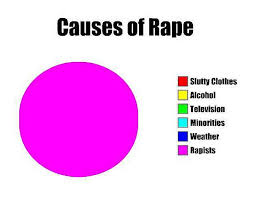
I am also offended that Yoffe decides to write an article about college women getting raped because they drink as a response to a 14 year old rape victim whose case was dropped by their horrible police because the family of the alleged rapist is rich. The real cause of rape is shown below.  If only the white male dominated media was required to take Introduction to Women’s Studies, the perpetuation of rape culture might be minimized.

causes of rape

The Sex Object Test

My few followers know I’ve been planning a media literacy conference for the last year. It came to fruition this weekend.  Over 125 attendees attended the 16 workshops, two panels and a keynote.  The keynote was informative, compelling, depressing, and educational.  For those of you unlucky enough to miss it, I’m going to recap some of the information passed on to the group over the next few weeks. 

Dr. Caroline Heldman is a professor of Politics at Occidental College and bad-ass feminist. She is also a political commentator for MSNBC, Fox Business News, RT America, and Al Jazeera English.
Professor Heldman earned her Ph.D. in Political Science from Rutgers University and specializes in the American presidency and systems of power. She previously taught at Whittier College, Fairfield University, and Rutgers University. Professor Heldman graduated summa cum laude with a degree in Business Management from Washington State University, and has worked extensively in the private sector, including as the General Manager of Bio-Energy Systems and Research Manager for Consumer Health Sciences. Dr. Heldman’s work has been featured in the top journals in her field, including the American Political Science Review, the Journal of Politics, Political Psychology, and Political Communications. She co-edited the popular book, Rethinking Madame President: Is the US Ready for a Woman in the White House? (2007). Dr. Heldman’s work has also been featured in popular publications, including the New York Times, U.S. News and World Report, Ms. Magazine, The Huffington Post, and The Daily Beast. She has also been active in “real world” politics as a congressional staffer, campaign manager, and campaign consultant. Professor Heldman drove to New Orleans the week after Hurricane Katrina to assist with rescue and relief efforts. She co-founded the New Orleans Women’s Shelter and the Lower Ninth Ward Living Museum.

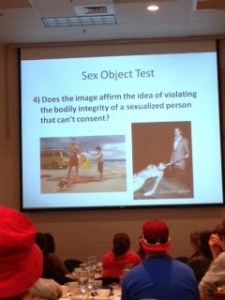
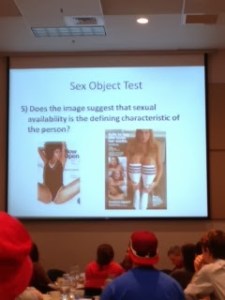
One of the major points of her talk “The Sexy Lie” was the notion that young people have been so saturated by women’s bodies being used as sex objects that they cannot discern when it is actually happening.  So she (and some colleagues, I believe) developed The Sex Object Test.  Use this to critically examine what you are seeing on TV, in the movies, and particularly in advertising.

1.  Does the image show only part(s) of a sexualized person’s body?

2.  Does the image present a sexualized person as a stand-in for an object? 

3.  Does the image show a sexualized person as interchangeable? 

4. Does the image affirm the idea of violating the bodily integrity of a sexualized person that can’t consent?

5.  Does the image suggest that sexual availability is the defining characteristic of the sexualized person?

And lastly,
6.  Does the image show a sexualized person as a commodity (something that can be bought and sold)?

If you can answer YES to any of these questions, you are looking at a person as a sex object and thus someone who is not a whole human being.  The prevalence of this type of advertising and marketing leads to not only women’s self hatred, but a continued dismissal of women’s power and leadership abilities in our culture.

If you find this fascinating, see her full talk here:  

We were blessed by the feminist goddesses to get to see her live and in person!

To see Tweets on the conference, search #educating4change. 

Educating for Change

It’s probably cheating, but I am one of the group of amazing feminists blogging for Soapbox now and did my first one last week on the Educating for Change conference coming up this weekend.  I have had no time to blog at all the past two weeks, so I post this in case you missed it!  

My first blog post with Soapbox!

Policing Women’s Sexuality

Last week I helped oversee a program at First Year Orientation.  (Most of my colleagues still call it Freshmen Orientation even though the University has had an inclusive language policy for years.  It’s one of those battles I just can’t seem to win.  When I went to the University of Maine in 1992, they had already stopped using the term Freshmen.)  At Orientation, the students participated in an educational theatre program where short skits were performed and then students could interact with the actors in character about the topic being introduced.  The four skits included one addressing racism and sexism, one addressing alcohol, one on the combination of alcohol and sexual assault, and one on consent.

In general the students responded as one in my field of student affairs and social justice would hope.  Yet there were a few outliers that left me with a sick feeling.  After the consent skit, two different women, in two different groups, stated that the woman deserved what she got because she was “teasing” her boyfriend. The story goes that a young couple return from a party.  The young woman’s roommate is gone for the weekend.  They begin kissing and the woman states she doesn’t want to have sex that night.  The boyfriend misses every possible clue and forces himself on her.  The woman makes multiple signs of no, including saying no, pushing him away, removing his hand and telling him that they don’t always have to have sex when they are together.

I left this day thinking a lot about these two women who have been socialized by our media saturated society to honestly believe that if they are kissing a guy that means they have to give it all the way up.  Whatever happened to the bases analogy?  And those of us who are old married folks KNOW that kissing certainly doesn’t always lead to sex, it often leads to a good night’s sleep.

One woman even said to the actress playing the rape victim “You deserve what you got and you should get off the floor crying like a little bitch.”  It took everything in my power not to pull this young woman out of the audience and give her a pile of books to read and an old fashioned talking to! 

Then last night I went out to dinner with a friend who told me she had seen a mother and two little girls at the beach this summer, all wearing bikini’s.  The mom had a lower back tattoo (referred inappropriately by our sexist culture as a “tramp stamp”) and the little girls had fake matching tattoos in the same place.  Her immediate response was that this was wrong and the mother was a horrible mother for allowing it.  I suggested that maybe the term “tramp stamp” much like the term “slut” was the policing of women’s sexuality by patriarchy.  Yeah, I know that’s a wee bit theoretical, but it makes a lot of sense.  Her comment begged the question of where the term “tramp stamp” even came from.  And oftentimes we don’t take the time to question origins of cultural expressions we take for granted.

Then we talked about whether those girls wearing fake tattoos on their lower backs was sexualizing them.   I said they were just trying to look like their mom and that it was only sexualized if we allow it to be.  What is the difference between putting a fake tattoo on your lower back or your arm?  If we allow for a certain body part to be sexualized, then yes.  When The Vagina Monologues first cam e out, everyone was freaked out about that word.  Now it’s commonplace. Isn’t that the whole issue with breast feeding in public?  Women’s breasts have been sexualized by the policing of our sexuality by male supremacy that women get flack for feeding their babies.

At the very core of this analysis is a history of oppression of women’s bodies.  To be too comfortable in our skin and free to express our sexuality is something that must be controlled and prevented.  I attribute the whole Brazilian waxing phenomenon to this and to the porn industry.  Women have been policed to the point where they think that having pubic hair is dirty.  And men (and other women) contribute to this policing by talking badly of women they suspect having hair. 

I am happy to be a middle aged married woman who doesn’t have to live in a world where my body is constantly being policed to fit into a narrow spectrum of sexuality.  I mean there’s that whole “you must be skinny” culture, but at least I don’t have to look like an 8 year old girl. 

Miley Cyrus: A ReCap

I’m not much of a television watcher these days.  Partly because I am getting ready to dump my cable that has gotten too expensive and partly because our TV lost the color red and everyone is green so we have to watch this tiny flat screen meant for our workout area. Thus, I did not see the VMA’s.

But I certainly followed all the hubbub about Miley Cyrus, former child star sweetheart, and so-called slut.  And I can’t say anything from a feminist, anti-racist point of view that has already been said, but I can put together a montage of my favorite commentary.  This is my favorite, sent to me by my feminist friend in Switzerland.

 
And here is another:

A Comedian’s Take On The Miley Cyrus Debacle Completely Changed What I Thought Of It

And lastly, one of my favorite sex bloggers, “Sex with Timaree,” writes this:  Sex with Timaree.

As you can surmise, from my favorite posts, there has been way too much slut shaming of this woman and very little discussion on who produces the VMA’s and who directs them.  This is a theatrical production, in many respects, that is choreographed and directed.  Ms Cyrus might have some artistic choice in what she gets to perform, but you can be sure that it was not her sole decision.

Now, let’s move on to the more serious issues of the world.  Bombing Syria? 

Solidarity is for White Women: A Re-cap

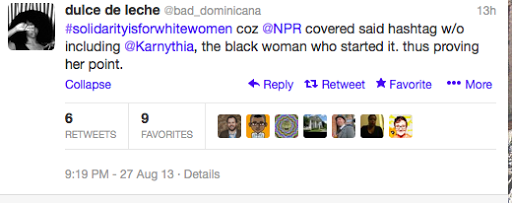
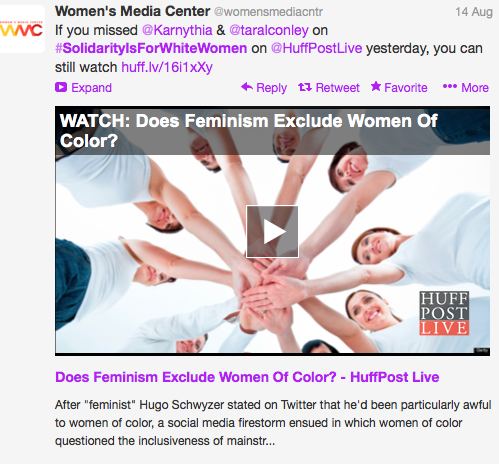
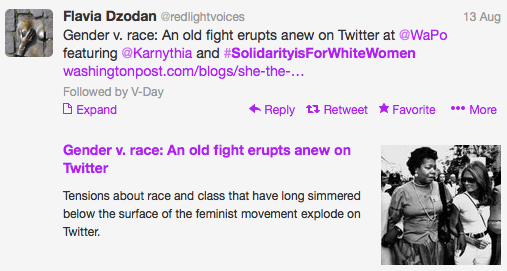
This past week, via Twitter, originally started by blogger Mikki Kendall, the hashtag “solidarityisforwhitewomen” trended as a statement that white feminism leaves out women of color.  (History behind solidarity is for white women hashtag).  (NPR Story) The hashtag went global.  I picked up on this trending and then got to watch it and learn.  I recommend you search #solidarityisforwhitewomen, but I have included some great examples. 

This story is nothing new.  This dialogue was part of my education in Women’s Studies, that women of color did not have a voice at the so-called feminist table.  Women of color were left out of this very white “problem that has no name” movement.  Women of color were left out of the suffragist movement.  Look around the tables where you sit.  What do you see?  I see that we are still not doing a good job at being inclusive.  My workplace is a microcosm of the world.  There are very few women of color on our faculty, or men of color, for that matter. 

Many of the tweets include great examples from media and pop culture that reinforce white privilege, power and white supremacy.   As someone who considers herself a social justice critic of media, I know, as a white women, I notice sexism instantly, but I have to continue to push myself to see the racism. This hashtag, this trend, is asking white women to do just that.  Push yourself, learn, and LISTEN.  Actively listen. It was listening to my friend Cynthia that got me interested in the drama Scandal.  When I learned the history of how few black women had held the lead in a network drama, I was shocked and appalled. (My take on that subject). 

I often criticize an artistic director friend of mine for not producing enough plays by women and people of color.  His response is that he produces a lot of shows by gay men and that he “can’t cover every cause.”  This is the kind of non-intersectional thinking that we get stuck in and one that gets perpetuated in our society. Last year I decided I couldn’t subscribe to theatres who don’t make an EFFORT, even just the slightest effort, to diversify their seasons.  What does this mean?  It means I’m not supporting the arts with my dollars.  I’m picking and choosing what shows I see instead of subscribing.  It means I’m not watching much television today because I’ve become too wary of watching something that misrepresents people. So what else can we do as white feminists who want to eliminate racism and end white supremacy? 

When I was teaching Women’s Studies, one question I always asked my students was “what if the women’s liberation movement of the 70s and the civil rights movement of the 60s had joined up?”  What if groups representing oppressed people weren’t divided up and given pieces of a pie to share? 

Mikki Kendall has a great article in XOJane this week talking about next steps. 

What this hashtag trend has done for me is to challenge me to be even MORE intersectional in my work with student and in my own thinking.  We’re starting out the semester by doing a privilege worksheet to lay this stuff all out on the table at once.  We’re running a social justice media literacy conference and I’m asking all the presenters to keep an intersectional analysis of race, gender, class and sexuality as the foundation for all their talks/workshops.

And I’m looking in the mirror, constantly reminding myself to pay attention and to call out that misrepresentation wherever I see it:  the workplace, the media, and in the theatre.

Two Axes to Grind

Two things on my mind this week.  Well, three actually.  First, feeling guilty that I didn’t write a blog last week.  It’s strange how I have to be motivated, pissed off, or concerned about a topic to cover it here.  Kind of like now that I’m in my 40s, I can’t go in the pool unless I am really hot.

So my guilt is now off my chest and I will continue to work on being a human who doesn’t feel guilty.

Yesterday I read an email by a colleague about a campaign on campus encouraging students that it’s ok not to drink.  Part of the campaign will involve staff and students wearing t-shirts that express this notion.  My colleague asked us to sign-up with our t-shirt size. I called her and asked her what type of t-shirts they were.  She replied “non gendered t-shirts.”

First I have to say that this colleague, and dear friend of mine, is most definitely a radical feminist.  I would never question this.  However, I have been someone, over my almost 22 years in higher education, who has become a true hater of the “non gendered t-shirt.”  Let’s deconstruct this.  These t-shirts, first of all, are NOT non-gendered.  They were designed for men, plain and simple.  If you are a woman with no boobs and no hips, yeah, sure, you can probably look okay in a small or a medium, but if you have a woman’s shapely body, in anyway, you’re in trouble.  First, the t-shirts are always too long.  If you try to fit one according to length, they probably won’t fit your chest, or you’ll look like a pancake.  If you try to fit one according to your chest size, it’s probably going to look like you’re wearing a mini-dress or a mu-mu. 

I’m not sure why a men’s t-shirt is somehow considered the “neutral” t-shirt, particularly in student affairs where we buy t-shirts all the time.  All my colleagues think I’m over-the-top, but this is another way, as a society, we expect women to conform to what we think is neutral or normal, like all those gendered words:  freshman, chairman, mankind, etc.

There are so many other examples of this.  Cars.  Cars are made with men’s bodies in mind.  There is no place to put your pocketbook.  It comes slamming off the passenger seat if you have to stop suddenly.  Seat belts that aren’t adjustable cross by your neck if you are a petite woman.  I’d love to hear more examples of this from my followers.  Even my desk at work is designed for a man.  For me to sit properly at my computer I have to keep my feet on a foot rest because they can’t reach the floor.  And I’m not THAT short!

And we buy these men’s t-shirts in the name of cost-savings.  We frugal student affairs practitioners say “I can’t afford to order two TYPES of t-shirts.  It would be too expensive.”  I’m just asking that we think about how what we often call non-gender is really gendered. And as for me, I’ll wear a men’s t-shirt if only I can re-purpose it to look cute. (Repurpose a men’s t-shirt) 

My second Ax to grind is really about AXE Body spray, gel, soap, cologne, or whatever they encourage boys and men to wear.  Their commercials are so sexist they make me want to puke.  The latest one explains that women, I mean, GIRLS, are getting hotter and hotter, which is a world crisis.   There are so many things wrong with this commercial.  First of all, to equate women’s attractiveness with a world crisis when there are people being slaughtered in the Middle East is ethnocentric.  Second, they refer to women as girls, which shows they are marketing to a young male market.   And I’m shocked more men are not complaining that not only are these advertisements sexist but that they make men look like idiots and bumbling fools.  Seriously.   Make sure you’re not having breakfast or lunch as you watch this.  

Philanderers, Sexual Harassers, and Johns! Oh Boy!

Rob Filner.  John Edwards.  Bill Clinton.  Eliot Spitzer.  Mark Sanford.  David Vitter. Larry Craig.  Anthony Weiner.  
What do these names have in common?  They are all white men, first of all.  They have law or business degrees, except for the fine Mayor of San Diego who has a Ph.D.  in the History of Science and was a History Professor at San Diego State before running for office.  They are all philanderers, sexual harassers, or Johns.  Oh!  And, they are politicians.
With Anthony “Carlos Danger” so present in this month’s media and Filner taking his two week intensive “re-hab” for assaulting his female colleagues, I spent some time researching the men who came before them in the long tradition of philandering politicians.  
Filner’s two week hiatus from his job as Mayor is “to address his ‘intimidating conduct’ and failure to respect women” (http://www.10news.com/news/mayor-bob-filner-begins-behavioral-therapy-at-undisclosed-location-080513).  Let’s deconstruct his so-called “intimidating conduct.” 
Of the ten women who have come forward, their allegations involved him asking them to work without panties, grabbing their asses, kissing them, touching their faces and asking if they will sleep with him.  See the detailed disgusting list at this link, but be sure to have an empty stomach: Accusations.
What he has done is not simply “intimidating conduct” but sexual harassment and in some cases, sexual assault. Whoever his Olivia Pope is who decided that to come out and say he was going to get two weeks of intensive therapy for decades of “cringe-worthy” behavior is brilliant.  He should not only step down from his job, but he should be sued for his behavior and possibly charged with assault.
In my humble radical feminist opinion, women should be screaming for him to step down.  The fact that these men –and yes, these politicians with issues are men– (we don’t hear about female politicians behaving this way) continue to “serve” as public servants makes me sick. 
Out of the list at the top, many of these men, after their falls from grace, continue to pursue public service jobs.  Eliot Spitzer is running for Comptroller of New York, which seems like a big step down from Governor.  Mark Sanford just became a U.S. Representative of South Carolina in a special election, after serving as Governor of that state.  David Vitter is a U.S. Senator from Louisiana.  His involvement with the DC Madam scandal merely affected his run for Governor of Louisiana.  Larry Craig no longer serves in office but opened a consulting firm that deals with energy issues, a.k.a., he’s a lobbyist.  Bill Clinton has become a major philanthropist and supporter of his wife, Hilary Rodham Clinton.  And it appears that John Edwards is gearing up to get back in the so-called political saddle. 
None of these men have had their lives ruined by their so-called inappropriate behavior nor their, in some cases, illegal behavior.  I’d like to be Superman, turn back time and put women in their places and see what kind of after effect shows up with women harassing, cheating and buying prostitutes.  I would bet their lives would be touched forever by those indiscretions.  The double standard starts in high school and continues long into our lives.  
But how do we as a culture accept this behavior?  I’m shocked that these ten women are just NOW coming forward to call out the lewd and illegal behavior of Filner.  I can’t even look at his picture without gagging and seeing the spittle on the cheeks of women who are Deans, College Administrators, Rear Admirals, and businesswomen.  We need to speak up when we see, hear or experience this type of behavior and call it unacceptable and illegal. 
But I know how institutions work.  And often, when someone cries out, the institution does everything in its power to cover, hide or sweep the truth under the rug.  When I was 21, I worked at the Norfolk Yacht and Country Club as a waitress.  The Assistant Manager sexually harassed me one night as I was walking through the closed dining room.  He motioned to his leg and pointed out how long his penis was.  I complained to the Manager, a woman.  She said he was “just kidding.”  I was too young and naïve to know I should have gone over her head.  Plus this was two years before Anita Hill spoke her truth.  We live in a culture where sometimes it’s not worth the headache and the struggle to speak the truth, particularly if you won’t be believed nor get any redemption for the crimes against you. 

A Media Vacation

Last Tuesday, we loaded up the camper and took off for the 23rd Annual Grassroots Festival of Music and Dance in Trumansburg, New York.  The drive takes six hours and for most of it we listened to music on the radio or on my iphone.  That evening we swam at the pond, had dinner with my family and sat around a campfire  talking and laughing.  No TV was watched that day.

The next day we hung out by the pond some more.  (It was in the high 90s).  And later that day my husband and I went out for an early dinner with my brother and his lovely partner at a restaurant called Stonecat in Hector, NY and off to play nine holes.  The night ended, again, by the campfire by the pond. My birthmother’s husband built a pyramid style campfire that night.  I began to avoid social media as well.  No TV was watched that day. 

On Thursday the men in my group (my husband, brother and a friend) biked the three miles into town where our cars were lined up to get into the festival.  I got dropped off a few hours later.  We were in and set up at the festival by 12:40pm.  The next four days were spend by our campsite at the festival, seeing live music at one of the four stages, eating at the vendors, or heading out to the pond for an afternoon cool down.   No posts to Facebook.  No Tweeting.  No TV was watched those four days. 

We didn’t read any newspapers.  I left my iphone in my camper top drawer merely so I could hear if I got a text from someone local, usually asking if we needed anyone to pick up beer or ice.  We saw some great music.  My top three include DriftwoodThe Mad Tea, who I have loved since first seeing them at the Shakori Hills Grassroots Festival in 2005, and Spam Allstars, who “blend improvisational electronic elements and turntables with latin, funk, hip hop and dub to create what they call an electronic descarga.” I always love seeing one of my favorite bands Donna the Buffalo

We leisurely packed up the camper on Sunday to make it back to the pond for dinner and a final campfire before we took off on Monday morning.

A week without any media (other than live music) is something more of us should experience.  Most of what I write about for this blog is about critiquing what I see on the TV or hear about in the news.  I didn’t have much that pissed me off all week except hearing the stories from my family of the Pro-Fracking folks in the area.  Perhaps I would be less pissed off if I was less engaged with the media.

As I drank my coffee Tuesday morning and watched a bit of the Today show with my nieces and in-laws, I wanted to throw up.  The two big news items were that the Pope’s car  had been surrounded by people in Rio, as his driver took a wrong turn, (surrounded by Catholics dying to get a blessing?  Oh my God!) and the new baby of the Duke and Duchess of Cambridge.  These two examples were enough to make me want to throw out our TV.

Spend a day or two away from media and see if it changes your perspective a bit.

my feminist praxis

critical reflections on my feminist praxis: activism, motherhood, and life

The Feminist Critic

Providing weekly critiques of theatre, film, books, politics and pop culture from a feminist perspective.